
A Technical Look at the World Champs 100m Hurdles
Got finished grading a mountain of papers the other day and decided to treat myself by looking at some photos from the World Championships. Of course, I'm always looking to see what I can pick up technically, so this article will take a look at some photos and provide some analysis of the women's 100 meter hurdles. I'll focus on Michele Perry (since she won), but also take a look at Perdita Felicien and Ginny Powell.
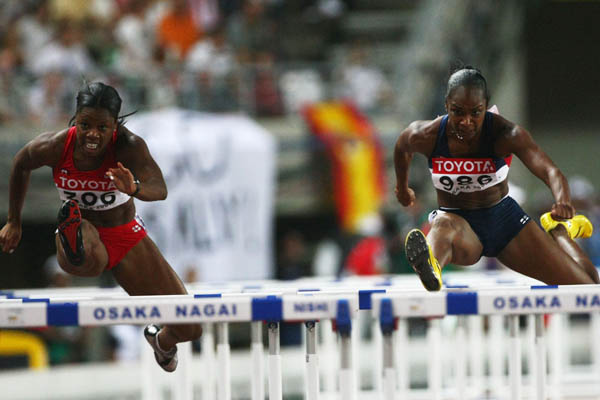
Okay, let's start with the photo on the left, where Felicien
and Perry are both on top of the hurdle. Both have a nice lead leg, bent at
the knee and attacking the crossbar. Perry's is better because not only is her
toe pointing up (as Felicien's is), but her foot is rotating downward, making
her "taller" over the hurdle than Felicien. For Felicien, there is
definitely too much space between her hamstring and the crossbar. Hurdle clearance
doesn't need to be that high, so she is certainly spending more time in the
air than is necessary. In terms of upper body, Felicien is leaning a little
more than Perry, which is appropriate because Felicien is an inch or two smaller.
Both have a low lead arm that is close to the body. Chin and eyes? Good. Trail
arms? Felicien's is excellent, while Perry's is pulling back a bit too far,
and I don't like how the thumb of that hand is pointing backward, whereas Felicien's
is pointing straight down. Felicien is therefore in a better position to punch
the trail arm back up, while Perry's is more likely to swing in a circular motion.
Now let's look at trail legs. I don't like Perry's at all. The only significant
flaw in Perry's technique - not just in this photo, but overall - lies in the
motion of her trail leg. Here, look how the foot is above the knee, and how
width is being created in the groin area. The trail leg foot should never
be above the trail leg knee. Felicien has a much tighter trail leg motion. See
how her foot is below the knee, driving upward, not outward. So even
though Felicien is higher in the air than she needs to be, she'll still get
back to the ground quickly because the nice tight angle of the trail leg will
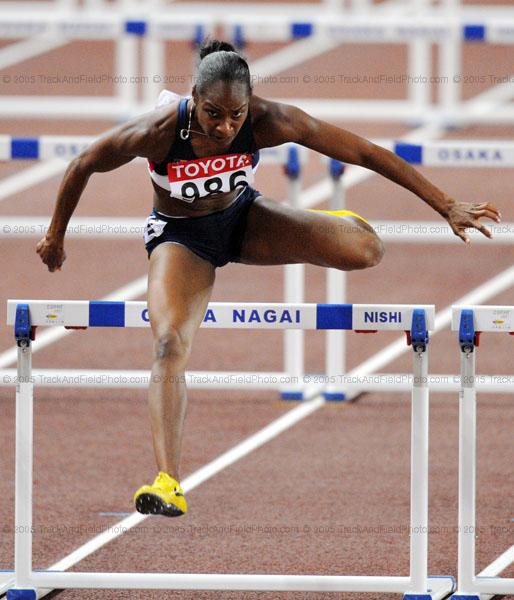
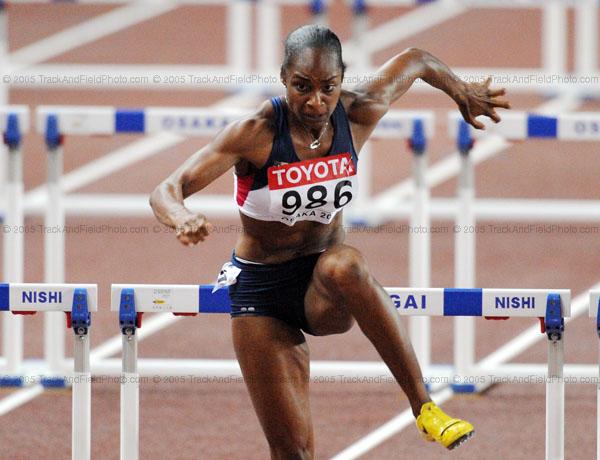
help to push the lead leg down. The middle photo and the photo on the right
reveal the subsequent problems caused by Perry's trail leg. In the photo on
the left, the arms were very tight. In the other two photos, especially the
middle one, her arms are very wide. Why is that? Because she had to open up
the lead arm to give the trail leg the extra room it needed to come through.
If she had a tighter trail leg motion, there'd be no need to "open the
door" of the lead arm so widely. Notice how, in the middle photo, her trail
leg is parallel to the crossbar. The knee is pointing outward, facing the hurdle
in the lane beside her. The knee should never be at such a wide angle, because
if it is, you'll end up looking like Perry looks in the photo on the right.
The lead leg has landed, but her hips are twisted, her lead arm is pulling back
too far and high, and the trail leg is still working its way around to the front.
Until it finally gets there, she won't be able to run again.
From a technical standpoint, my favorite female hurdler is Ginny Powell, and I'll explain why in breaking down the photos below.
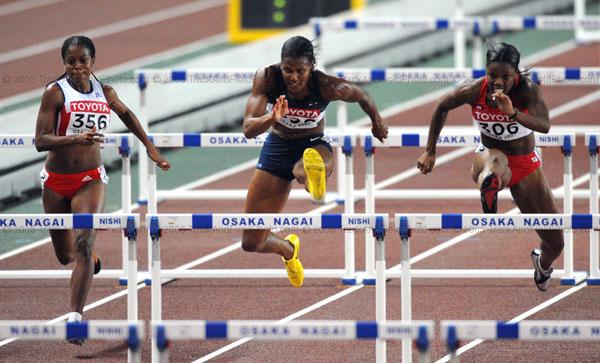
In this photo, Powell is demonstrating excellent technique as
she approaches the hurdle. Everything is moving in a straight line -- the lead
leg, the lead arm, the lead foot. The trail arm is bent at the elbow. The shoulders
are relaxed. The eyes are facing forward and the trail leg is not flaring out
widely. Felicien, too, looks very nice in this photo. Powell is leaning more
than she needs to. She's 5-9 or so, and the hurdles are only 33 inches, so she
barely needs to lean at all. But I'll be honest with you, I like the way she
leans into the hurdle. No, actually, I love the way she leans into
the hurdle. I've always felt that forward lean does more than just assist with
hurdle clearance. More importantly, it helps you to increase speed coming off
the hurdle. I like female hurdlers who hurdle like male hurdlers. All this "upright"
stuff that so many people preach when it comes to the women's hurdles doesn't
work for me. No, you don't want to lean like a guy going over a 42-inch hurdle,
but you do want a pronounced lean because leaning makes it so much easier to
drive the hips forward, to keep the shoulders square, and to accelerate off
the barrier.
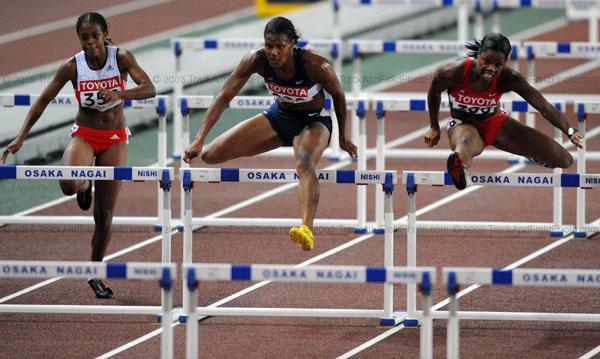
In this photo, Powell's lead leg is on its way down. The toe
remains pointing up, the knee remains bent, and her hamstring is skimming the
crossbar. Excellent. Her trail leg is coming upward in a tight motion, allowing
her to maintain a tight motion with her lead arm. And check the upper body:
torso pushing forward, shoulders square, hips straight. She's in a great power
position to drive through the hurdle and hit the ground running. You can see
that Felicien is beginning to have problems. Her neck is tilting to her trail
leg side. Her hips are off-line, but obviously, her speed will carry her through
these technical mistakes. Her trail arm is in a good position and she still
has plenty of forward momentum.
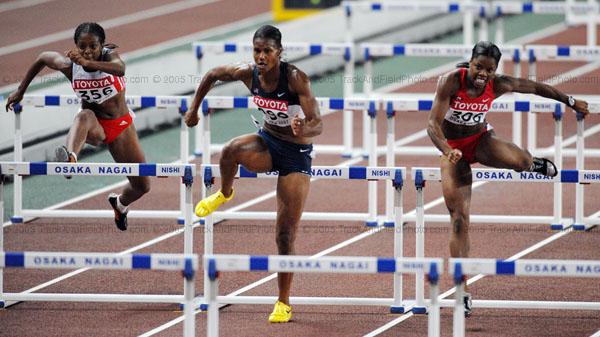
Now Powell has touched down. Everything is in an excellent position.
There will be no pause, no waiting on the trail leg. She is ready to sprint
without any need for realignment or recovery. She's standing tall on the ball
of her lead foot. The knee of her trail leg is already facing the front, with
the toe pointing up. So she can drop it quickly and make a smooth but aggressive
transition back into sprinting motion. Trail arm is punching back up already.
Hips are square, shoulders are square. There are absolutely no balance problems.
Felicien is struggling here. The way her trail leg foot and lead arm are flaring
out, it looks like she might have taken off too close to the hurdle. Her hips
and shoulders are off-line as well. It could be that her trail leg was late
in driving upward, which can also cause that tilt that we see. When the trail
leg is slow, the natural reaction is to compensate by twisting the hips.
Interesting, Powell and Susanna Kallur (who is not pictured in these photos) have the best technique among the female hurdlers in my opinion, but Perry is the World Champion. Perry has tremendous speed, and her technique is sound except for her trail leg. In the women's race, with the hurdles being so low, it's easier to sprint between the hurdles than it is for the men, so the race often goes to the best pure sprinter, not always to the most technically sound or the one with the quickest feet between. That's why they need to raise the damn things.
© 2007 Steve McGill