Practice with Wayne Davis
My friend the photographer Derek Bradley came to practice again last week and took some more outstanding photos. The ones below are of Wayne Davis, who was working on a drill for most of the workout.

In this drill Wayne was focusing on developing a faster cadence
between the hurdles. We have come to the decision that his technique is pretty
much as good as it's going to get, and that the only way to run faster times
is to get stronger and to run faster between the hurdles. Because of his height
(5-10) and the fact that his flat sprinting speed is not at the level of top-notch
sprinters, we are trying to develop a faster cadence not by shuffling, but by
running faster. The goal is to take off closer to hurdles, to get crowded, and
then rely on his hurdling instincts to get him up and over the hurdle in a limited
amount of space. So, this drill was designed specifically for him (and largely
by him) in order to address a specific issue. In this photo, the hurdles
are very close together, so Wayne is, in fact, shuffling. But as the workout
went on, we gradually moved the hurdles further apart, focusing on maintaining
the same cadence while taking longer strides.

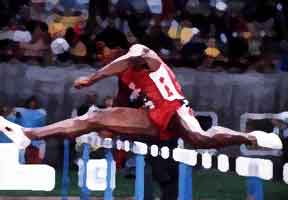
Here, Wayne is on top of the hurdle. The knee of the lead leg
is driving up very high, into his chest, as the chest simultaneously comes down
over the thigh. Notice also that the toe of his lead leg is pointing up. Were
he to let the toe drop, he would hit the hurdle. Also, bringing the knee up
high is a way to adjust to the limited space, as we are anticipating that that's
the problem he will face once he starts to really sprint between the hurdles.
The knee of the trail leg is also driving in an upward/forward direction, with
the groin opening up to allow space for clearance. But both knees are going
forward, driving upward. To drive the knee of the trail leg forward while the
groin is opening up requires a lot of strength and flexibility in the core area,
which Wayne has. His arms, too, are driving in an up-and-down motion. In this
photo, it may look like the arms are going across the body, but they're not.
The elbow of the lead arm is opening up to allow room for the trail leg to whip
through. We want the trail leg to begin its whip as soon as it leaves the ground,
whereas I used to teach that we wanted it to pause after leaving the ground,
and then whip through as the lead leg snaps down. The trail leg whipping as
soon as it leaves the ground enables Wayne to get into hurdlng position sooner,
and with more speed going into the hurdle. Most hurdlers' trail leg, at the
point of clearance shown in this photo, would be much lower, putting more pressure
on the lead leg to create speed, which it is really unable to do.

Coming off the hurdle, Wayne's lead leg drives downward, with
the ankle remaining flexed. He maintains his forward lean from the waist, thereby
carrying his speed through the hurdle and off the hurdle. Hips are aligned,
shoulders are aligned; there are no balance issues. The knee of the trail leg
is driving straight up into the chest, so that he will immediately be able to
return to sprinting once he touches down. The lead arm is now driving downward
and the trail arm is beginning its punch back up, also signaling a return to
sprinting motion. Notice too how the ankle of the trail leg remains flexed to
avoid clipping the crossbar with that foot.

Here, Wayne is about to touch down. The flexed ankle of the lead
leg will help cushion the landing and facilitate a powerful push off the track
so that his hips won't drop. As with the previous photo, everything is aligned
for a seamless return to sprinting. Hips, shoulders, knees are all facing forward.
The foot of the lead leg will land directly above the hip. Eyes are looking
straight ahead, chin is up. The knee height of the trail leg will ensure an
effective sprinting stride off the hurdle.
© 2009 Steve McGill