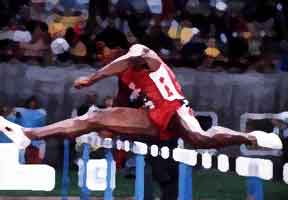

Stay Low
A habit that gets a lot of hurdlers into a lot of trouble is that of running with an upper-body posture that is too erect. There are four key moments when a hurdler must be aware of the need to stay low and drive forward:
1. Coming out of the blocks
2. In the last two or three steps into the first hurdle
3. Coming off each hurdle
4. Coming off the last hurdle
Running too tall at any of these moments will inhibit acceleration and overall velocity, thus preventing the athlete from maximizing the speed he or she has. Let’s talk about them in order.
Coming out of the Blocks
The mantra of this article will be, Don’t be so concerned about the hurdle
that you forget to run. That advice begins with the first step. A lot of hurdlers
want to “see” the hurdle as soon as possible, so they’ll pop
up out of the blocks and stand straight up instead of driving forward on a horizontal
plane. Their desire to see the hurdle so soon actually causes that first stride
to be shorter than it would otherwise be, thus making it harder to get to the
hurdle in the desired amount of strides with the desired take-off distance.
This sudden shift in weight kills all of the momentum that using starting blocks
is supposed to provide to begin with. Practicing your start often enough should
provide a sure “feeling” of how long each stride needs to be. You
don’t need to see the hurdle in the first stride, or even the second or
third stride. Those first three strides should be spent powering out of the
blocks ala a 100-meter sprinter. There are only two times in a race when a hurdler
has the luxury of being a pure sprinter – into the first hurdle and off
the last hurdle. So you have to take advantage of those two parts of the race
by putting as much speed into each one as possible.
The Last Two or Three Strides into the First Hurdle
For the sake of convenience, let’s assume we’re talking about an
eight-step approach to the first hurdle. I would argue that, by the fourth stride,
as your eyes rise up to see the crossbar, you’re already as tall as you
need to be to clear the first hurdle. Most of us, though, keep rising until
we’re at full sprinting height by the eighth step. If you’re that
tall that soon, you’re going to reach top speed too soon, and will therefore
begin decelerating before you even reach the midway point of the race. At the
first hurdle, you should still be rising to full height. Otherwise, assuming
your first steps out of the blocks were executed effectively, you will lose
all the speed you gathered up to that point, and will have to re-accelerate
when you land off the first hurdle. Even if your first seven steps are perfectly
placed, the eighth step alone can ruin all your momentum. That happens quite
often, because, at the eighth step, many of us tend to “prep” for
the hurdle instead of running through the hurdle. “Prepping” for
the hurdle often involves shifting the torso into a more erect position right
before clearing the hurdle. Don’t do that. Keep your torso pushing forward.
Stay low. Don’t be so concerned about the hurdle that you forget to run.
Coming off Each Hurdle
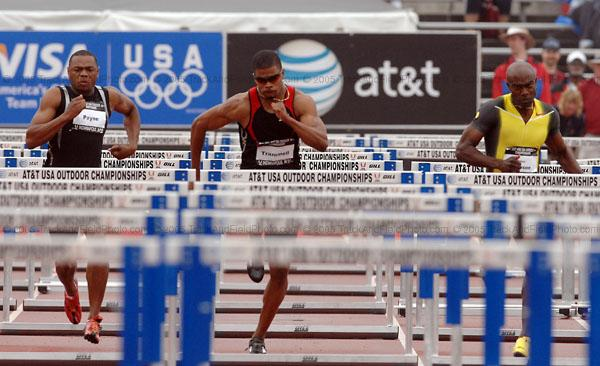
A common mistake among hurdlers is to “stand up” when coming off
hurdles. As we snap down our lead leg and drive our trail leg through, we simultaneously
raise our torso back into erect position. The key is to maintain the push forward
from the torso as the lead leg snaps down. Standing up off the hurdle, just
like standing up in the last step before the hurdle, causes a loss of momentum
and, again, a need to re-accelerate. Who wants to go down the track constantly
accelerating, decelerating, and re-accelerating? Nobody. Yet that’s what
a lot of hurdlers do. Of course, your chest should not be as forward between
the hurdles as it is when you are on top of the hurdles, but still, you want
to maintain as much forward momentum as you can.
Coming off the Last Hurdle
For this one, we’re not just talking about the lean across the finish
line. We’re talking about the whole phase of the last part of the race
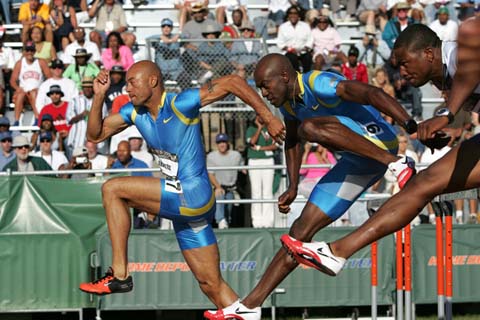
– off the final hurdle and through the finish line. Off the last hurdle,
stay low. You should feel like you’re about to fall forward on your face.
While Terrence Trammell is someone I would consider a master of the lean across
the line, I’d say that David Oliver and Liu Xiang are the best male hurdlers
when it comes to coming off the last hurdle. When they touch down, they don’t
straighten back up at all, but kind of just keep plowing forward like a fullback
in football. Any time spent standing back up, even to the slightest degree,
could cost precious hundredths of seconds. Basically, off the last hurdle, you
want to just let your momentum carry you forward.

Final Thoughts
When in doubt, stay low. While technique is important, speed should never be
compromised for the sake of technique. The race goes to the fastest hurdler,
not the prettiest. So, one more time, don’t be so concerned about the
hurdle that you forget to run.
© 2009 Steve McGill