While almost all hurdlers take eight steps to the first hurdle, there are a few who take seven. This article will discuss the benefits of seven-stepping, as well as the dangers involved in trying it.
Is Seven-stepping Practical?
Firstly, the seven-step approach to the first hurdle is designed for the taller hurdler. By taller we’re talking about 6-2 or taller. Modern hurdlers who seven-step are Cuban Dayron Robles and American Antwon Hicks, both of whom are in the 6-3 to 6-4 range. A notable old school hurdler who used to seven-step was Finland’s Arto Bryggare, who won the bronze medal at the 1984 Olympic Games. Bryggare was very tall – somewhere in the 6-7 range. For such hurdlers, seven-stepping just makes more sense because it eliminates the need to chop strides in the approach to the first hurdle, thereby allowing them to run more naturally. Both Robles and Hicks have had much success hurdling indoors at the 60 meter distance, which can largely be attributed to the advantage they gain by seven-stepping. If that’s the case, then why shouldn’t everybody take seven steps to the first hurdle?
Not for Smaller Hurdlers
For smaller hurdlers, switching to seven-stepping is generally an unnecessary risk. Though you can cover more ground, the stride lengths required to reach the optimal take-off distance will create the need to stretch the strides too much. Even very powerful smaller hurdlers with great leg strength will struggle to make it to the first hurdle at the type of take-off distance that will enable them to continue to accelerate to hurdle two.
Should All Taller Hurdlers Seven-step?
I don’t think so. The problem with seven-stepping, even for taller hurdlers who can seven-step easily, is that the rhythm changes dramatically between the rest of the hurdles. To the first hurdle, you might be able to open up your stride and run more comfortably, but then you’ll have to instantly switch to the quicker shuffling method of running between the hurdles. Of course, you can get used to that if you practice it enough, as Robles obviously has, considering he has run 12.92 outdoors.
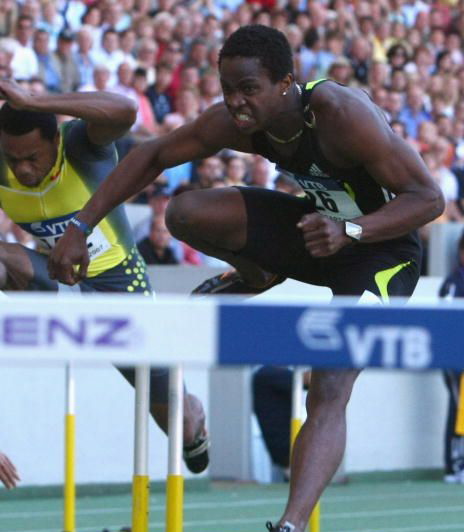
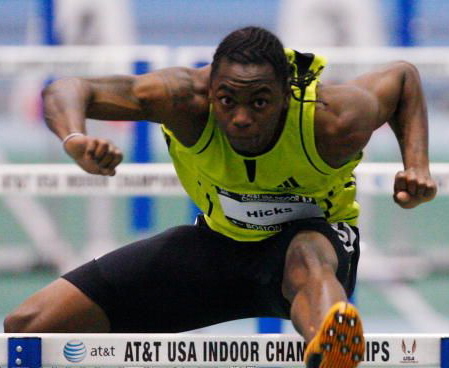
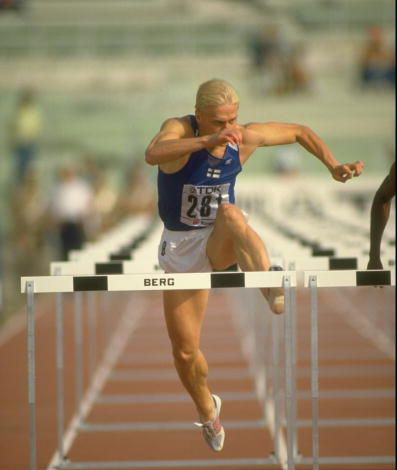
From left to right: Dayron Robles, Antwon Hicks, and Arto Bryggare all have successfully used a seven-step approach to the first hurdle.
What Are the Advantages of Seven-stepping?
The obvious advantage is that it gets you to the first hurdle faster, enabling you to put pressure on your opponents to catch you. And we all know that when other hurdlers are trying to catch you, they’re more prone to make mistakes. The seven-step looksslower because the legs aren’t turning over as quickly, but it’s actually faster because of the one less stride. If you watch any of Robles’ best races closely, you’ll notice that he begins to create separation from the competition at the fourth or fifth step. But the key to knowing for sure that the faster start is actually helping more than hurting you is your touchdown at the third hurdle, not the first hurdle.
What Adjustments are Needed to Seven-Step?
The biggest adjustment is that of switching the feet in the blocks. That will feel odd at first, and it will take a while to develop the power out of the blocks that you had with your feet the other way. Also, the arms will swing in opposite directions than what they’re used to. And that will take some time to adapt to as well.
Final Advice
If you’re going to try to make the switch to seven-stepping to the first hurdle, give it time. It’s a major adjustment, and must be implemented during the off-season, before the heavy schedule of meets starts to pile up. If you’re going to try to make the switch after the competitive season is underway, you’ll need to accept that you’ll have to use the early-season races as practice sessions. You’ll have no choice but to train through them in order spend the time you’ll need to master the change in your start.
© 2008 Steve McGill
