
The Robles Factor
 While
Liu Xiang has created separation from the rest of the world’s elite 110
hurdlers and is still a major favorite to repeat as Olympic champion when the
Games come to his native country of China in 2008, there are several hurdlers
out there who could give him some trouble. One of them is young Cuban sensation
Dayron Robles. After a disappointing fourth-place finish at the 2007 World Championships,
Robles went on to dominate in September, defeating the likes of Xiang, Terrence
Trammell, Anwar Moore, and others. His best race, a world-leading 12.92 at the
World Athletics Final, tied him for the fourth-fastest time ever. This article
will take a look at Robles’ hurdling style. When someone’s running
this fast, you’ve gotta take notice and ask, What is he doing that enables
him to run so fast? Let’s take a look:
While
Liu Xiang has created separation from the rest of the world’s elite 110
hurdlers and is still a major favorite to repeat as Olympic champion when the
Games come to his native country of China in 2008, there are several hurdlers
out there who could give him some trouble. One of them is young Cuban sensation
Dayron Robles. After a disappointing fourth-place finish at the 2007 World Championships,
Robles went on to dominate in September, defeating the likes of Xiang, Terrence
Trammell, Anwar Moore, and others. His best race, a world-leading 12.92 at the
World Athletics Final, tied him for the fourth-fastest time ever. This article
will take a look at Robles’ hurdling style. When someone’s running
this fast, you’ve gotta take notice and ask, What is he doing that enables
him to run so fast? Let’s take a look:
First of all, at 6-4, Robles is one of the tallest hurdlers out there today. Hurdlers his height aren't supposed to be as good as he is. They encounter too many problems with rushing up on hurdles, hitting hurdles, and generally just feeling like they just don't have enough space between the hurdles to do what they need to do. Probably the greatest taller hurdler ever was 6-3 Greg Foster, who won four World Championships in the 1980s and '90s as well as an Olympic silver medal. Foster ran many great races throughout his extensive career, but he was also known as a prolific timber-crasher who always might go down, and, in attempting to regain balance, always might take somebody else down with him. Like most taller hurdlers, Foster most often got into trouble when he was hurdling from behind, trying to gain ground on a quick-starting opponent. While Foster may be one of the most obvious examples, I can't think of any taller hurdlers who didn't have this problem. Except Robles. So what does he do differently. How is he able to negotiate the barriers while maximizing his speed without crashing hurdles? There are a few key factors.
 The
Lead Leg:
The
Lead Leg:
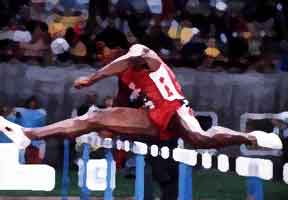
Robles' lead leg is unique. He uses it in a style that I would say is essential
for big men, but I've never seen any other elite hurdlers do it. Describing
what he does is not easy, but I'll try my best. To put it simply, his lead leg
is always on the way down. It's never on a plane that is parallel to the ground.
Smaller hurdlers have to extend the lead leg on a parallel angle in order to
clear the crossbar cleanly without sitting on the hurdle as they begin to snapdown.
So, Robles' style wouldn't work for someone in the 5-10 to 6-0 range. But for
taller guys, extending the lead leg outward before snapping it down is an extra
motion that can be negated simply by effectively taking advantage of their height.
If you're already looking down on the hurdle, then when the lead leg extends,
it should extend downward, not outward. That's how Robles does it. That's how
he reduces airtime and gets back on the ground so quickly. I remember one time
when I was in college, I had just run a preliminary race at our conference meet,
and then was watching the next round, which featured the favorite. He was 6-3.
I remember watching his race and marveling at how hurdling looked so easy to
him. He was coming at the hurdles at a different angle than I was. It looked
like he was always looking down on the hurdles, just stepping over them. When
looking at Robles, I'm reminded of that hurdler. The angle is the same, but
Robles' lead leg is also extraordinarily quick and forceful, not just fluid
and smooth. So when he touches down, having driven that lead foot under his
hips, he really accelerates off the hurdle and continues to generate more speed.
For someone so tall, there is no margin for error. To simplify the physics,
it's easy to see that the closer he lands to the hurdle he just cleared, the
more room he has to sprint to the next one. Were he to sail down over a hurdle,
that would mess up his rhythm to the next one, and might ruin his rhythm for
the rest of the race. Bigger guys have less room to recover, so everything with
the lead leg has to be precision perfect. No doubt, Robles' lead leg is precision
perfect.
The Cut Step:
One thing that both Xiang and Robles do exceptionally well is shorten their
last stride into each hurdle. Allen Johnson, although smaller, is also very
good at this. Same with Ladji Doucoure, even though he has technical problems
on top of the hurdle. While all three strides between hurdles are much shorter
than a natural sprinting stride, the third stride needs to be even shorter.
When looking at the likes of the above-mentioned hurdlers, you can see when
they run how they seem to thrust themselves into the hurdle, creating the illusion
that they are actually accelerating, as opposed to losing speed, when clearing
each hurdle. This illusion is created by cutting that last step, which helps
to drive the foot under the hips and shifts the upper-body weight forward, thereby
literally propelling the hurdler into the hurdler. Robles is as good as anybody
at doing this. At his height, he has to be. Check out video footage of any of
his races and you'll see that if his third step were as long as his second step,
he'd be crashing into hurdles all day long. With the cut step, he gives himself
just enough room to get the lead leg up and to, as I just said, accelerate through
the hurdle.
Lead Arm, Trail Arm, Lean:
Robles' lead arm is very nice. He keeps it in a tight box, in a fluid rotary
motion. On the way down, the arm is very forceful, like he's hammering a nail.
Yet there's no excessive motion. The lead arm works together with the lead leg
to create acceleration off the hurdle. Both complete their downward flight at
the same time. His trail arm doesn't do much of anything, but it doesn't hurt
him because the elbow stays bent and he doesn't swing the arm in any direction.
It returns to running motion when he lands, and there is no pause with it, so
it's effective. His lean is modified compared to most high hurdlers. But his
height dictates that he not lean too much. He leans enough to drive himself
through the hurdle, and he does lean from the waist in a chest-over-thigh motion.
Trail Leg:
To me, the only aspect of Robles' hurdling technique that needs work is his
trail leg. This is where Xiang is the better hurdler, and if Xiang wins another
gold medal in '08, the trail leg will be the major reason why. If you look at
Robles closely, you'll notice that he has some back-kick in his stride between
the hurdles. This habit leads to his trail leg initiating its motion by kicking
back instead of driving upward with the toe pointing up and the heel tucked
underneath the butt. Once his trail leg gets moving, its motion is a bit wide,
which is caused by the initial back-kick. With Xiang's trail leg, on the other
hand, there is no back-kick at all. The heel instantly drives under the butt
and the knee drives upward as soon as the foot leaves the ground, so that the
trail leg looks like a lead leg. Robles' trail leg isn't quite as efficient,
although, except for that initial back-kick, it does look very nice and function
very effectively.

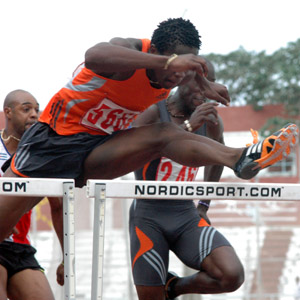
This photo shows the difference between Xiang's trail leg and
Robles'. Obviously, Robles has hit the hurdle so he has lost balance, but still,
we can see the point that Xiang's trail leg knee is driving upward, with the
knee higher than the foot, while Robles' trail leg is swinging around on a wider
plane.
Final Thoughts:
Simply put, Robles is a beast. He's a great athlete, a highly-skilled technician,
and he'll only be 21 in Beijing. So he is still very much on the upswing of
his career, and he still hasn't mastered the event. He has made significant
improvements in his technique just in the past year. Plus, the fact that he
has defeated Xiang previously means that he has already cleared that psychological
hurdle. The level of performance that he showed in the latter part of 2007 --
in the post-WC meets -- puts him on a level of equal footing with Xiang if you
ask me, despite his fourth-place finish at the WC's. You might throw Terrence
Trammell into that mix, since he is the only other hurdler who ran sub-13. in
2007. But Trammell hasn't beaten Xiang, and he hasn't proven that he can hold
off Xiang's late-race surges. As for Robles, I like his chances in Beijing,
and I'd venture to say that if he eliminates the back-kick and tightens up that
trail leg, he might break the world record before the Olympic Games.
© 2007 Steve McGill
Youtube
footage of Allen Johnson's 12.96 at the 2006 World Cup provides a good look
at the things discussed about Robles in this article. The ground-level slo-mo
angle toward the end of the video is particularly useful.