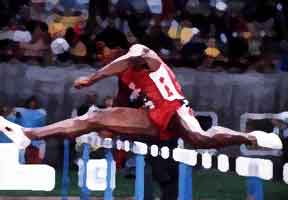

The Phases of a High Hurdle Race
Recently I received an email from a coaching friend of mine asking me to discuss the phases of a sprint hurdle race from start to finish. I don’t consider myself an expert on that topic, but I guess I know enough to write an article on it without sounding stupid. So, here goes. Broadly speaking, a 100m/110m hurdle race can be divided into three phases:
1. Starting line to the third hurdle (Acceleration)
2. Fourth hurdle to seventh hurdle (Top speed)
3. Eighth hurdle to finish line (Deceleration)
Starting Line to Third Hurdle:
This is the phase of the race in which the athlete is accelerating toward full
speed. Often, we think of the “start” as being the approach from
the starting blocks to the first hurdle. But the athlete is still accelerating
well after the first hurdle. He or she continues to accelerate through the second
and third hurdle, and doesn’t reach full speed until the fourth hurdle.
Likewise, it is ideal that the hurdler not reach full height until the third
hurdle as well. If a hurdler is too tall too early, he or she will reach top
speed too soon, and therefore begin to decelerate after the fifth hurdle or
sixth hurdle instead of after the seventh hurdle.
Fourth Hurdle to Seventh Hurdle:
Here, the hurdler has reached top speed – has shifted gears, so to speak.
If the first phase of the race has gone well, the hurdler now feels like he
or she is “rolling,” and the greatest danger lies in the possibility
of running up on hurdles and getting too crowded. To master this phase of the
race, it’s important to practice over five or six hurdles in practice
to get used to the increased speed in order to learn to “dance”
between the hurdles. No more than six reps would be advised, because too many
reps will decrease the speed and ruin the point of the workout. A lot of the
time, this phase of the race is where the better hurdlers pull away from the
pack. Their sprinting speed is part of the reason why, as well as their ability
to attack the hurdles aggressively without compromising their speed, which is
a matter of courage and discipline. Inexperienced hurdlers will slow down to
avoid crashing. Hurdlers who lack foot speed and have to stretch their strides
to reach the hurdle will generally begin to lose ground in this stage of the
race. The lack of foot speed makes it impossible to keep pace, regardless of
how good their technique may be. Such hurdlers need to either focus on the long
hurdles or do a lot of quickness drills to improve their leg turnover.
Eighth Hurdle to Finish Line:
This is the “uh-oh” stage of the race, when mental breakdowns can
occur and technical flaws will be exposed. Reflexes slow down, and hurdlers
may lose their ability to react to the barriers. It also becomes more difficult
to recover when hitting hurdles. But for the well-prepred hurdler, “uh-oh”
doesn’t have to come into the equation. There is no way to avoid decelerating
in this stage of the race. The key is to stay relaxed in the uppoer body, to
maintain efficient sprinting form between the hurdles, and to maintain efficient
hurdling form over the hurdles. Coming off the last hurdle to the finish line,
it’s important to make sure you clear the last hurdle before dashing to
the finish line. We all know what happened to Gail Devers in 1992, but she’s
not the only one that has happened to. With automatic timing and photo finishes,
it’s essential to lean into the finish line at the precisely correct moment.
I’ll never forget how Terrence Trammell’s lean in the 2004 Olympics
earned him a silver medal when he could’ve finished as far back as fourth
if he had leaned too late or had ducked down his head instead of pushing his
torso forward.
The best hurdlers don’t have a “weak” phase of their race. They get out well, they maintain their speed, they stay in attack mode even when the hurdles are rushing up at them, and they stay relaxed and focused when fatigue sets in. Running a good hurdle race is very, very difficult. It requires constant practice of all the race’s phases. When all the phases come together in a fluid, seamless manner, oh, what a beautiful feeling.
© 2007 Steve McGill